Plus, most of the people who knew his dad are long dead. 😦
And now you made it extra rude
NOT COOL, PEOPLE- NOT COOL!
On the 12th July 2065, the Knight Bus pulled up outside a special street in London. Not many people used it anymore— not since the new Wizarding Taxi Service had been set up a good forty years before, promising all of the convenience of the Knight Bus with none of the motion sickness. But so far it had still managed to cling on to life, though now it mainly served aging witches and wizards who still remembered it from its glory days, and the odd group of young people riding it for a dare (and usually getting very sick in the process— though that was probably mainly the fault of the large quantities of firewhisky they often brought with them).
Today, the only passenger getting off at the Diagon Alley stop was an elderly man— though not as old as you might think, for a wizard— with snow white hair that still never lay flat, bright green eyes that looked out through round rimmed glasses, and a lightning shaped scar on his forehead.
“G’bye Mr Potter!” the conductor called out.
“Cheers Ted!” the old man called back, “And hey, tell your Grandad I said hi!”
“I will Mr Potter!” the young man said, grinning widely. “He’ll be right chuffed at you remembering him. He still talks about the war, y’know. Says you and him were instrumental in defeating Voldemort… oh, sorry.” he paused, clearly having only just remembered that you weren’t supposed to say his name in front of the older generation.
“It’s fine, Ted.” Harry said. “Fear of a name only increases fear of the thing itself, after all.” and he walked down the steps, only just resisting the urge to laugh. Stan Shunpike obviously hadn’t changed a bit if he was going round telling people he’d been instrumental in ending the war. Harry was only surprised that he wasn’t claiming to have won the whole thing single-handedly.
He waited, under the pretence of reading a poster some muggle had stuck on what they thought was a brick wall— something about a missing cat— until the bus had hurtled off again, down the road and round the corner. Then he reached inside his bag, a new one that Hermione had bought him for Christmas last year— “it’s the latest one, Harry. You could hold a house in one of these things! Makes that one I took horcrux hunting look like a cupboard.”
“Yeah,” Ron had added, giving Hermione an affectionate kiss on the cheek as he did so, “who know? Maybe some day they’ll finally have invented a bag big enough to carry all your books.“— and he pulled out his invisibility cloak.
He didn’t really need it all that much nowadays. Gone were the days when he couldn’t walk down a street without being begged for autographs. People who didn’t know him didn’t tend to recognise him much now. Sometimes he felt sure that, no matter how much he aged, in the public eye he’d always be the tall, skinny teenager who defeated Voldemort. He couldn’t really blame them for choosing to stop time there. Occasionally— but more often when he visited Diagon Alley, where the ghosts were particularly strong— he’d find that he started thinking of himself, not as the young man he had been, or the old man he had become, but as a boy. A small, skinny, rather undernourished boy in hand-me-down clothes and broken glasses fixed with tape.
“You look just like your father,” he remembered someone— so many someones— saying to him, “except for your eyes,” an image pops into his head, of a pale man with greasy hair dying on the floor of the Shrieking Shack (now the site of the Remus Lupin Werewolf Support Society, another of Hermione’s projects, he’s still got his badge somewhere)— “you have your mother’s eyes”.
The eyes, at least, are the same, but nobody’s said he looks like his father for decades. Not since his once jet black hair turned first grey, then white, and his face gained one too many wrinkles to ever again remind anyone of a man who’d died at 22.
Besides, there was nobody left now who had known his father. The last of the Marauders had died in the war, the few teachers, classmates and Order members who might remember him were long gone. Perhaps there were a few left— wizards live so much longer than muggles— but, if so, Harry never met them, and if he did he doubted that any of them would connect the laughing boy they had known with the old man they saw before them.
It was strange to think how much the likeness had mattered to him once. He used to feel like it connected him to his father in some way, felt proud when people commented on it— now he was almost glad they’d stopped.
The shadows of the past hung over him far too much already.
He hestitated, making sure that he was fully covered by the cloak, and then walked through what any muggle would have seen as just an ordinary, rather grubby, brick wall with a cat poster on it, and what anybody with even a trace of magic in tgem would have clearly seen as the doorway to the Leaky Cauldron.
It was, as always, rather crowded in there, and Harry had to make quite an effort so as to avoid jostling someone and possibly causing a panic. He did end up accidentally knocking over a pint glass, so that it’s contents spilled all over the table and dripped onto the floor, but luckily the owner didn’t see who did it, and so instead of panicking merely started a rather loud argument with the man standing directly behind Harry. Harry himself made his way out of the back entrance and into the alley, before he could cause any more trouble.
At first glance, Diagon Alley was the same as it had been that first magical day that Hagrid had taken him to buy his school supplies.
There was still the same atmosphere of freedom and excitement— it would have reminded Harry of the end of term, if that time hadn’t always been associated in his own mind with grim despair and a longing to go back to school— that you always got in those few places where witches and wizards were free to use magic without worrying about running into muggles. Still the same tempting but (Harry had to remind himself even now) totally unecessary magical objects placed tantalisingly in the windows of shops— including a solid gold and silver chess set, and a globe that not only rotated in midair, orbited by a miniature moon, but also appeared to change cloud formations depending on what the weather was like in different parts of the world.
Hell, since wizarding fashions seldom changed dramatically, instead cycling through endless variations on the theme ‘cloak and pointy hat’, it could even have been the same people passing by him now as had passed by him all those years ago, if it weren’t for the fact that they would all be much older now, and a lot of them were probably dead.
But there had been changes as well.
Olivander’s was still there, only now it was not run by an Olivander, but by somebody else— Harry couldn’t remember the name now, but there’d been a thing about it in the ‘Prophet a few years ago. Some ex-Durmstrang student had decided to reopen it under the old name. There had been complaints at the time, but they had since died down. Apparently she made very good wands.
Madame Malkin’s was gone though, replaced by Wizwitch, a shop that according to the sign, sold “all the latest fashions, at all the lowest prices”.
Weasley’s Wizard Wheezes was still doing good business— nobody had even heard of Zonko’s Jokeshop nowadays— but the site of Flourish and Blotts was now home to Longbottom’s Garden supplies (young Frank Longbottom had inherited his father’s love of Herbology, if not his talent for teaching).
And, of course, the space that had once been set aside for Florean Fortescue’s Ice Cream Parlour (and now had a small plaque mounted outside it to commemorate that fact) was now occupied by a great stone building, with a mural of a golden bird painted over the doorway, flapping its wings in the flames, and below it the words: ORDER OF THE PHEONIX MUSEUM.
As always, Harry had to pause for a moment upon entering the museum (it was free admission, of course, Hermione had been very insistent about that). No matter how many times he visited, he never got used to it.
In front of him, behind a wall of glass not disimilar to the one he had one vanished to free the python at the zoo, stood sixth plinths. On them, in order, stood an old diary with a hole through the middle; a ring with a cracked stone (a replica— Harry had never told anyone where the real one was); a broken locket with a serpentine ’S’ engraved on it; a golden goblet; a silver tiara set with a blue gem in the middle, and, on the last and largest plinth, the reconstructed skeleton of a simly enormous snake.
In front of the display, an eager looking museum attendant was talking excitedly to a group of children and their parents, telling them about the origins of each horcrux and how it had been destroyed.
These attendants were the reason Harry was wearing the cloak. They tended to be Wizarding War enthusiasts, and tended to be knowledgeable enough about it that they might just be able to recognise him even if he didn’t look much like the pictures on the Chocolate Frog Cards anymore (did they even still do Chocolate Frog Cards? Now he came to think about it, he hadn’t seen a Chocolate Frog on sale for years).
He didn’t mind them too much, but he knew that if they knew he was here then they would insist on making a fuss, dragging him around all the displays and showering him with questions about the old days.
Ron had refused to set foot in the place since the first visit, and nothing he, Hermione and Ginny could say had been able to persuade him otherwise. “Theykept following me around,” he complained, “asking what it was like. So I told them: it was bloody awful and we kept nearly getting killed— and they laughed, like they thought I was joking.”
“Well,” Hermione had said, “you can’t expect them to take it as seriously as we do. Most of that lot weren’t even born when You-Know— when Voldemort was defeated. It’s all ancient history to them.”
“It’s payback, Ron,” Ginny had said, “for all those times you didn’t pay attention during Binns’ history classes. Somewhere, up there,” she pointed at the sky, “a thousand goblin rebels are laughing at you.”
“Whatever.” Ron had been adamant, “I’m not going back in there again.”
Hermione and Ginny didn’t visit much now, either.
“You’ve got to let go.” Ginny always told him, whenever he suggested it. “Yes it happened, and yes it was dreadful and important and we mustn’t ever forget it— but it’s over. And it was all such a long time ago. At some point, you just have to accept that, or you’ll go mad.”
“I’ve managed to avoid insanity so far.” he’d said the last time, trying to lighten the mood.
“Yes.” She’d replied, but she’d looked doubtful.
It wasn’t a question of forgetting it, he thought as he walked by Gryffindor’s sword in its glass case, and the portrait of Albus Dumbledore mounted on the wall (he could have sworn it winked at him as he walked past). There was no chance of him ever forgetting it. He still had the scars, for God’s sake. He still woke up screaming sometimes, convinced that it was all happening again and that this time he wasn’t going to be able to stop it, clutching his forehead against phantom pains in his scar.
He’d walked past quite a few exhibits by now— including reconstructions of the DA room and the Chamber of Secrets, and a gruesome replica of Mad-Eye Moody’s enchanted glass eye, swivelling round to glare at the small children who came to gawk at it. Harry occasionally thought about complaining about that— it didn’t seem quite respectful enough, somehow— but, on reflection, he thought as he watched a little girl tap the glass of the case and squeal as the eye turned and fixed upon her, he couldn’t really think of anything Moody would have liked better.
“Keep them on their guard!” he’d have said, what remained of his mouth smiling in approval. “Constant vigilance!”
Harry almost laughed, but the sound died in his throat when he caught sight of the next exhibit.
‘In Memoriam’ the black banner read, over the wall of framed photographs of everybody who had fought and died in the first and second wars against Voldemort. Fred, Tonks, Lupin, Snape, Dumbledore, Colin Creevey… all the people he couldn’t save.
Was it worth it?
That was the question he kept asking himself, the question that always drive him here, searching the past for answers.
Was it worth all the death, all the pain, all the fighting? Standing here, invisible, with a crowd of the dead waving at him happily from their frames, Harry wasn’t so sure.
They all looked so young.
Then, in the centre, was photo that was different to all the others. A group photo, rather than one with only one or two subjects, a photo that reminded Harry of standing in the house that had become his godfather’s prison, in the conpany of a man who had seen so many terrible things that his sense of perspective had been skewed to the extent that showing a boy the faces of his dead parents and their dead friends could be seen as a treat.
There they all were, still smiling. Lily and James, Frank and Alice, Sirius, Remus, Wormtail, Mad-Eye and all the others. ‘The Original Order of the Pheonix’, the label underneath read, followed by a list of names and birth and death dates. A lot of death dates.
For a moment Harry envied them their frozen moment of happiness. There were horrors in their future just like there were horrors in his past, but at least they didn’t have to remember them. The woman who had his eyes, and the man who looked so much like he had looked that it was as if he was looking at his 21 year old self again, had no idea that their son would be an orphan mere months after the photo was taken.
Suddenly, he heard a patter of feet behind him, and only just managed to leap out of the way before their owner— a small boy, about four years old, wearing a bright green cloak and clutching a toy wand— barged right into him. As it was, the boy ran past him, eager to get a closer look at the pictures.
He was young, probably much too young to know what he was looking at, andHarry watched him as he peered into the frames, waving back at all the funny little people inside.
“Phineas!” Ah, and here were the parents. “Phineas! Wait for Mummy and Daddy!” a flustered looking woman in a pale purple cloak was running after him, followed by a dark grey cloaked man who must have been her husband.
The boy continued studying the pictures, when suddenly simething seemed to catch his eye. “Mummy! Daddy! Look!” he said, jabbing a finger at the photo in the centre.
“Yes, sweetheart.” the woman said, “that’s the Order of the Pheonix. Remember, we told you about them? They helped defeat Voldemort.”
The child nodded, and Harry looked down in amazement at this child who would never know what it was the flinch at the name ‘Voldemort’. Who would never be told that his value was reduced down to his blood status. Who would never need to cling to photographs and stories and likenesses to feel a connection to the oarents who were now standing in front of him.
Yes. It had been worth it.
But the child wasn’t finished. “I know it’s the Order of the Pheonix.” he said, “but look!” he pointed again, more urgently, and Harry realised that he had singled out one of the figures in particular. “That man looks just like Harry Potter!”
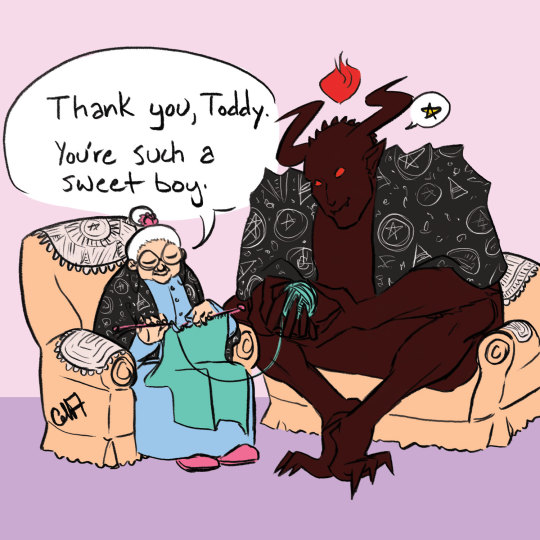
An old and homely grandmother accidentally summons a demon. She mistakes him for her gothic-phase teenage grandson and takes care of him. The demon decides to stay at his new home.
It isn’t uncommon for this particular demon to be summoned—from
exhausting Halloween party pranks in abandoned barns to more legitimate (more
exhausting) ceremonies in forests—but it has to admit, this is the first time
it’s been called forth from its realm into a claustrophobic living room bathed
in the dull orange-pink glow of old glass lamps and a multitude of wide-eyed,
creepy antique porcelain dolls that could give Chucky a run for his money with
all of their silent, seething stares combined. Accompanying those oddities are
tea cup and saucer sets on shelves atop frilly doilies crocheted with the
utmost care, and cross-stitched, colorful ‘Home Sweet Home’s hung across the wood-paneled
walls.
It’s a mistake—a wrong number, per se. No witch it’s ever
known has lived in such an, ah, dated,
home. Furthermore, no practitioner that ever summoned it has been absent, as if
they’d up and ding-dong ditched it. No, it didn’t work that way. Not at all.
Not if they want to survive the encounter.
It hears the clinking of movement in the room adjacent—the kitchen,
going by the pungent, bitter scent of cooled coffee and soggy, sweet sponge
cakes, but more jarring is the smell of blood. It moves—feels something slip
beneath its clawed foot as it does, and sees a crocheted blanket of whites and greys
and deep black yarn, wound intricately, perfectly, into a summoning circle. Its summoning circle. There is a small splash
of bright scarlet and sharp, jagged bits of a broken curio scattered on top,
as if someone had dropped it, attempted to pick it up the pieces and pricked their finger.
It would explain the blood. And it would explain the demon being brought into
this strange place.
As it connects these pieces in its mind, the inhabitant of
the house rounds the corner and exits the kitchen, holding a damp, white dish
towel close to her hand and fumbling with the beaded bifocals hanging from her
neck by a crocheted lanyard before stopping dead in her tracks.
Now, to be fair, the demon wouldn’t ordinarily second guess
being face-to-face with a hunchbacked crone with a beaked nose, beady eyes and
a peculiar lack of teeth, or a spidery shawl and ankle-length black dress, but
there is definitely something amiss here. Especially when the old biddy lets
her spectacles fall slack on her bosom and erupts into a wide, toothy (toothless)
grin, eyes squinting and crinkling from the sheer effort of it.
“Todd! Todd, dear, I didn’t know you were visiting this year!
You didn’t call, you didn’t write—but, oh, I’m so happy you’re here, dear!
Would it have been too much to ask you to ring the doorbell? I almost had a
heart attack. And don’t worry about the blood, here—I had an accident. My favorite
figure toppled off of the table and cleanup didn’t go as expected. But I seem
to recall you are quite into the bloodshed and ‘edgy’ stuff these days, so I
don’t suppose you mind.” She releases a hearty, kind laugh, but it isn’t
mocking, it’s sweet. Grandmotherly. The demon is by no means sentimental or
maudlin, but the kindness, the familiarity, the genuine fondness, does pull a
few dusty old nostalgic heartstrings. “Imagine if it leaves a scar! It’d be a
bit ‘badass,’ as you teenagers say, wouldn’t it?”
She is as blind as a bat without her glasses, it would appear,
because the demon is by no means a ‘Todd’ or a human at all, though humanoid, shrouded
in sleek, black skin and hard spikes and sharp claws. But the demon humors her, if only
because it had been caught off guard.
The old woman smiles still, before turning on her heel and
shuffling into the hallway with a stiff gait revealing a poor hip. “Be a dear
and make some more coffee, would you please? I’ll be back in a jiffy.”
Yes, this is most definitely a mistake. One for the record
books, for certain. For late-night trips to bars and conversations with colleagues,
while others discuss how many souls they’d swindled in exchange for peanuts, or
how many first-borns they’d been pledged for things idiot humans could have
gained without divine intervention. Ugh. Sometimes it all just became so pedantic
that little detours like this were a blessing—happy accidents, as the humans
would say.
That’s why the demon does as asked, and plods slowly into
the kitchen, careful to duck low and avoid the top of the doorframe. That’s why
it gingerly takes the small glass pot and empties it of old, stale coffee and carefully,
so carefully, takes a measuring scoop between its claws and fills the machine
with fresh grounds. It’s as the hot water is percolating that the old woman
returns, her index finger wrapped tight in a series of beige bandages.
“I’m surprised you’re so tall, Todd! I haven’t seen you
since you were at my hip! But your mother mails photos all the time—you do love
wearing all black, don’t you?” She takes a seat at the small round table in the
corner and taps the glass lid of the cake plate with quaking, unsteady, aged hands. “I was starting to think you’d never visit. Your father and I have
had our disagreements, but…I am glad you’re here, dear. Would you like some
cake?” Before the demon has a chance to decline, she lifts the lid and cuts a
generous slice from the near-complete circle that has scarcely been touched. It
smells of citrus and cream and is, as assumed earlier, soggy, oversaturated
with icing.
It was made for a special occasion, for guests, but it doesn’t
seem this old woman receives much company in this musty, stagnant house that
smells like an antique garage that hadn’t had its dust stirred in years.
Especially not from her absentee grandson, Todd.
The demon waits until the coffee pot is full, and takes two
small mugs from the counter, filling them until steam is frothing over the
rims. Then, and only then, does it accept the cake and sit, with some
difficulty, in a small chair at the small table. It warbles out a polite ‘thank
you,’ but it doesn’t suppose the woman understands. Manners are manners
regardless.
“Oh, dear, I can hardly understand. Your voice has gotten so
deep, just like your grandfather’s was. That, and I do recall you have an affinity
for that gravelly, screaming music. Did your voice get strained? It’s alright,
dear, I’ll do the talking. You just rest up. The coffee will help soothe.”
The demon merely nods—some communication can be understood
without fail—and drinks the coffee and eats the cake with a too-small fork. It’s
ordinary, mushy, but delicious because of the intent behind it and the love
that must have gone into its creation.
“I hope you enjoyed all of the presents I sent you. You
never write back—but I am aware most people use that fancy E-mail these days. I
just can’t wrap my head around it. I do wish your mom and dad would visit sometime.
I know of a wonderful little café down the street we can go to. I haven’t been; I wanted to visit it with Charles, before he…well.” She falls silent in her
rambling, staring into her coffee with a small, melancholy smile. “I can’t
believe it’s been ten years. You never had the chance to meet him. But never mind
that.” Suddenly, and with surprising speed that has the demon concerned for her well being, she moves to her feet, bracing her hands on the edge of the table. “I may as
well give you your birthday present, since you’re here. What timing! I only
finished it this morning. I’ll be right back.”
When she returns, the white, grey and black crocheted work with the summoning
circle is bundled in her arms.
“I found these designs in an occult book I borrowed from the
library. I thought you’d like them on a nice, warm blanket to fight off the
winter chill—I hope you do like it.” With gentle hands, she spreads the blanket
over the demon’s broad, spiky back like a shawl, smoothing it over craggy shoulders
and patting its arms affectionately. “Happy birthday, Todd, dear.”
Well, that settles it. Whoever, wherever, Todd is, he’s
clearly missing out. The demon will just have to be her grandson from now on.
this is so sweet. it made me want to hug someone.
i had to
I WOULD WATCH SIX SEASONS AND A MOVIE
Okay but she takes him to the little cafe and all of the people in her town are like “What is that thing, what the hell, Anette?” and she’s like “Don’t you remember my grandson Todd?” and the entire town just has to play along because no one will tell little old Nettie that her grandson is an actual demon because this is the happiest she’s been since her husband died.
Bonus: In season 4 she makes him run for mayor and he wins
I just want to watch ‘Todd’ help her with groceries, and help her with cooking, and help her clean up the dust around the house and air it out, and fill it with spring flowers because Anette mentioned she loved hyacinth and daffodils.
Over the seasons her eyesight worsens, so ‘Todd’ brings a hellhound into the house to act as her seeing eye dog, and people in town are kinda terrified of this massive black brute with fur that drips like thick oil, and a mouth that can open all the way back to its chest, but ‘Honey’ likes her hard candies, and doesn’t get oil on the carpet, and when ‘Todd’ has to go back to Hell for errands, Honey will snuggle up to Anette and rest his giant head on her lap, and whuff at her pockets for butterscotch.
Anette never gives ‘Todd’ her soul, but she gives him her heart
In season six, Anette gets sick. She spends most of the season bedridden and it becomes obvious by about midway through the season that she’s not going to make it to the end of the season. Todd spends the season travelling back and forth between the human realm and his home plane, trying hard to find something, anything that will help Anette get better, to prolong her life. He’s tried getting her to sell him her soul, but she’s just laughed, told him that he shouldn’t talk like that.
With only a few episodes left in the season Anette passes away, Todd is by her side. When the reaper comes for her Todd asks about the fate of her soul. In a dispassionate voice the reaper informs Todd that Anette spent the last few years of her life cavorting with creatures of darkness, that there can be only one fate for her. Todd refuses to accept this and he fights the reaper, eventually injuring the creature and driving it off. Knowing that Anette cannot stay in the Human Realm, and refusing to allow her spirit to be taken by another reaper, so he takes her soul in his arms. He’s done this before, when mortals have sold themselves to him. This time the soul cradled against his chest does not snuggle and fight. This time the soul held tight against him reaches out, pats him on the cheek tells him he was a good boy, and so handsome, just like his grandfather.
Todd takes Anette back to the demon realm, holding her tight against him as he travels across the bleak and forebidding landscape; such a sharp contrast to the rosy warmth of Anette’s home. Eventually, in a far corner of his home plane, Todd finds what he is looking for. It is a place where other demons do not tread; a large boulder cracked and broken, with a gap just barely large enough for Todd to fit through. This crack, of all things, gives him pause, but Anette’s soul makes a comment about needing to get home in time to feed Honey, and Todd forces himself to pass through it. He travels in darkness for a while, before he emerges into into a light so bright that it’s blinding. His eyes adjust slowly, and he finds himself face to face with two creatures, each of them at least twice his size one of them has six wings and the head of a lion, one of them is an amorphous creature within several rings. The lion-headed one snarls at Todd, and demands that he turn back, that he has no business here.
Todd looks down, holding Anette’s soul against his chest, he takes a deep breath, and speaks a single word, “Please.”
The two larger beings are taken aback by this. They are too used to Todd’s kind being belligerent, they consult with each other, they argue. The amorphous one seems to want to be lenient, the lion-headed one insists on being stricter. While they’re arguing Todd sneaks by them and runs as fast as he can, deeper into the brightly lit expanse. The path on which he travels begins to slope upwards, and eventually becomes a staircase. It becomes evident that each step further up the stair is more and more difficult for Todd, that it’s physically paining him to climb these stairs, but he keeps going.
They dedicate a full episode to this climb; interspersing the climb with scenes they weren’t able to show in previous seasons, Anette and Honey coming to visit Todd in the Mayor’s office, Anette and Todd playing bingo together for the first time, Anette and Todd watching their stories together in the mid afternoon, Anette falling asleep in her chair and Todd gently carrying her to bed. Anette making Todd lemonade in the summer while he’s up on the roof fixing that leak and cleaning out the rain gutters. Eventually Todd reaches the top, and all but collapses, he falls to a knee and for the first time his grip on Anette’s soul slips, and she falls away from him. Landing on the ground.
He reaches out for her, but someone gets there first. Another hand reaches out, and helps this elderly woman off the ground, helps her get to her feet. Anette gasps, it’s Charles. The pair of them throw their arms around each other. Anette tells Charles that she’s missed him so much, and she has so much to tell him. Charles nods. Todd watches a soft smile on his face. A delicate hand touches Todd’s shoulder, and pulls him easily to his feet. A figure; we never see exactly what it looks like, leans down, whispering in Todd’s ear that he’s done well, and that Anette will be well taken care of here. That she will spend an eternity with her loved ones. Todd looks back over to her, she’s surrounded by a sea of people. Todd nods, and smiles. The figure behind him tells him that while he has done good in bringing Anette here, this is not his place, and he must leave. Todd nods, he knew this would be the case.
Todd gets about six steps down the stairway before he is stopped by someone grabbing his shoulder again. He turns around, and Anette is standing behind him. She gives him a big hug and leads him back up the stairs, he should stay, she says. Get to know the family. Todd tries to tell her that he can’t stay, but she won’t hear it. She leads him up into the crowd of people and begins introducing him to long dead relatives of hers, all of whom give him skeptical looks when she introduces him as her grandson.
The mysterious figure appears next to Todd again and tells him once more he must leave, Todd opens his mouth to answer but Anette cuts him off. Nonsense, she tells the figure. IF she’s gonna stay here forever her grandson will be welcome to visit her. She and the figure stare at each other for a moment. The figure eventually sighs and looks away, the figure asks Todd if she’s always like this. Todd just shrugs and smiles, allowing Anette to lead him through a pair of pearly gates, she’s already talking about how much cake they’ll need to feed all of these relatives.
P.S. Honey is a Good Dog and gets to go, too.
the last lines of the show:
demon: you’re not blind here – but you’re not surprised. when…?
anette: oh, toddy, don’t be silly, my biological grandson’s not twelve feet tall and doesn’t scorch the furniture when he sneezes. i’ve known for ages.
demon: then why?
anette: you wouldn’t have stayed if you weren’t lonely too.
demon: you… you don’t have to keep calling me your grandson.
anette: nonsense! adopted children are just as real. now quit sniffling, you silly boy, and let’s go bake a cake. honey, heel!





 konekorambles